
Recasting Oscar History – 1929
Who would have won Best Casting at the 1st Academy Awards?
June 5, 2026 | Lisa Hatzenbeller
The first Academy Awards did not begin with a single Best Picture race. Instead, the Academy split its top honor between Outstanding Picture and Unique and Artistic Picture, creating a field that already stretched across very different ideas of cinematic achievement: spectacle, romantic melodrama, social realism, crime drama, and silent-era visual storytelling.
That makes this inaugural Recasting Oscar History exercise unusually open. If a Best Casting category had existed from the beginning, the race would not simply reward the biggest stars or the most celebrated film. It would ask a different question: which film assembled the strongest cast to bring its world and story to life?
For this project, we imagine how the Academy might have answered that question. The 1st Academy Awards ceremony honored films released between August 1, 1927, and July 31, 1928, with winners announced on May 16, 1929. The official field includes nominees from both top-picture categories.
Outstanding Picture Nominees
7th Heaven
(Outstanding Picture)
Total Oscars: 3 Wins • 5 Nominations
Acting Oscars: 1 Win • 1 Nomination
Chang
(Unique and Artistic Picture)
Total Oscars: 0 Wins • 1 Nomination
Acting Oscars: 0 Wins • 0 Nominations
The Crowd
(Unique and Artistic Picture)
Total Oscars: 0 Wins • 2 Nominations
Acting Oscars: 0 Wins • 0 Nominations
The Racket
(Outstanding Picture)
Total Oscars: 0 Wins • 1 Nomination
Acting Oscars: 0 Wins • 0 Nominations
Sunrise*
(Unique and Artistic Picture)
Total Oscars: 3 Wins • 4 Nominations
Acting Oscars: 1 Win • 1 Nomination
Wings*
(Outstanding Picture)
Total Oscars: 2 Wins • 2 Nominations
Acting Oscars: 0 Wins • 0 Nominations
* Indicates winner in its top-picture category
Narrowing the Field
Because the first ceremony had six combined top-picture nominees across two categories, the field must be narrowed to five. To determine which films advance into Best Casting consideration, total Oscar nominations serve as the tiebreaker. All Outstanding Picture nominees move forward, leaving the Unique and Artistic Picture lineup to decide the final spot. Under that approach, Chang is excluded with one total nomination and no acting nominations.
Best Casting Nominees
7th Heaven
The Crowd
The Racket
Sunrise
Wings
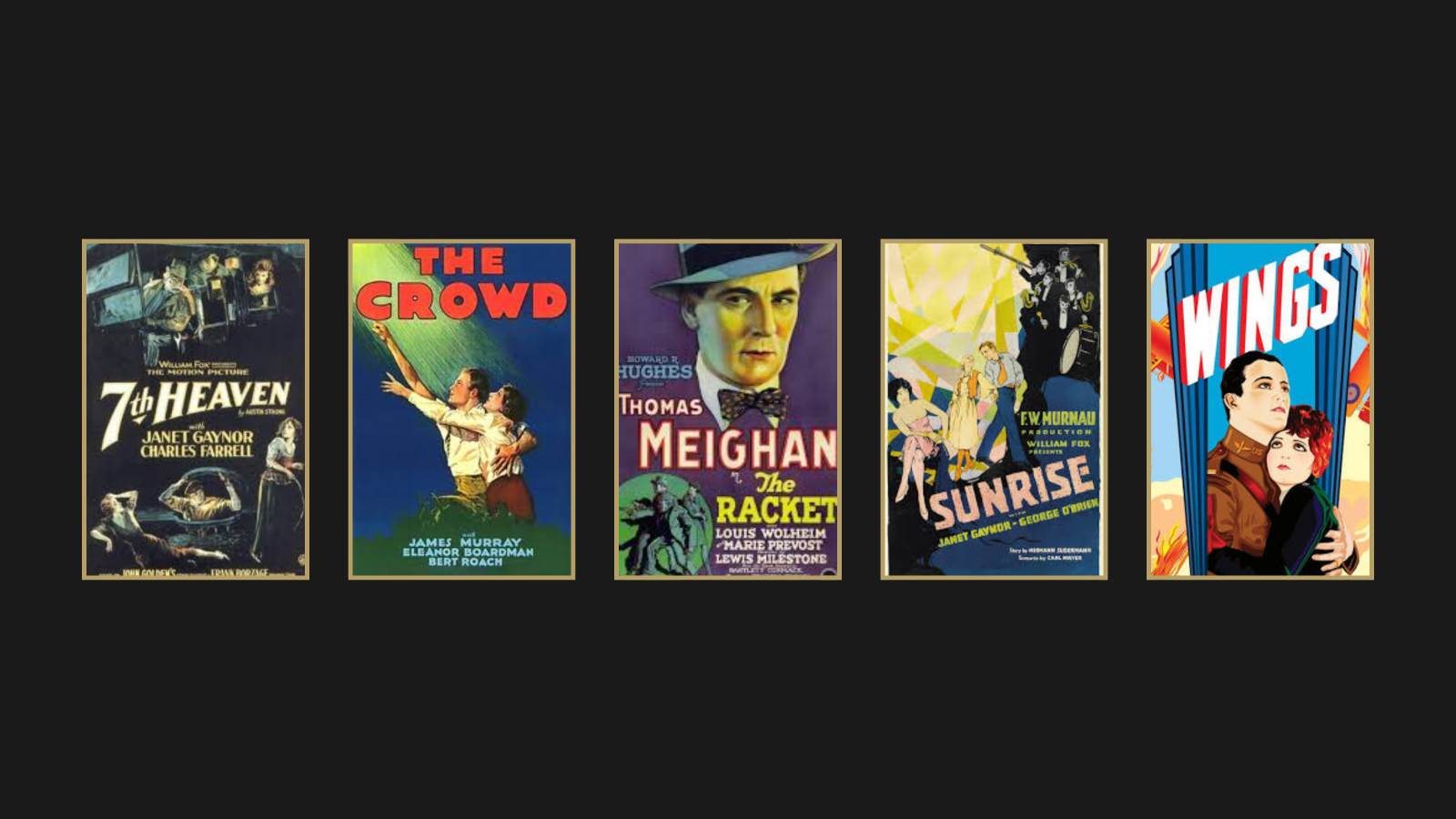
Who Would Have Won?
The films below are ranked through the Best Casting lens, weighing ensemble construction, casting difficulty, breakout value, chemistry, role-to-performer fit, and how strongly the cast shapes the film’s identity.
5ᵗʰ Place
The Racket
Key Cast: Thomas Meighan, Louis Wolheim, Marie Prevost, George E. Stone, Sam De Grasse, Richard “Skeets” Gallagher, and John Darrow
Casting Evaluation
The Racket assembles a crisp silent-crime lineup: upright resolve on one side, brute force on the other, with civic rot pressing in around both. The choices are precise and genre-savvy, especially in the way respectability, danger, and public corruption are set against one another.
Why This Casting Worked
- Thomas Meighan’s calm, respectable leading-man quality gives the police side a firm center.
- Louis Wolheim’s heavy physical presence and hard-edged character-actor persona make the gangster role feel forceful rather than decorative.
- Marie Prevost brings glamour and looseness that widens the film beyond a simple two-man conflict.
- George E. Stone brings a sharper, scrappier underworld energy that contrasts with Louis Wolheim’s heavier menace.
- Sam De Grasse’s severe presence helps the corruption angle feel tied to authority, not just street crime.
Where the Casting Fell Short
The supporting cast fills out the police station, nightclub, and political backrooms around the main struggle, but the film’s strongest casting argument still sits with Meighan’s restraint playing against Wolheim’s bruising force.
Casting Takeaway
The supporting cast fills out the police station, nightclub, and political backrooms around the main struggle, but the film’s strongest casting argument still sits with Meighan’s restraint playing against Wolheim’s bruising intensity.
4ᵗʰ Place
The Crowd
Key Cast: James Murray, Eleanor Boardman, Bert Roach, Estelle Clark, and Daniel G. Tomlinson
Casting Evaluation
The Crowd poses a difficult casting challenge because its leads must anchor the story without seeming glamorous, polished, or elevated above the environment around them. John and Mary need to register as distinct people rather than grand protagonists, so the performers must support King Vidor’s city-scale design while keeping the marriage intimate. That equilibrium between anonymity and specificity is the section’s strongest argument.
Why This Casting Worked
- Murray brings a young, restless, slightly raw quality. He can look hopeful one moment and foolish or wounded the next. That makes John believable as someone who wants to be important but does not have the confidence, polish, or control to make that dream feel secure.
- Eleanor Boardman keeps Mary sympathetic even when frustration and disappointment enter the marriage.
- Murray and Boardman do not make John and Mary feel larger than the story. They fit the film’s scale. The audience can believe them as a young couple whose marriage is shaped by money worries, pride, disappointment, and loss.
- Bert Roach brings a relaxed comic rhythm to John’s social scenes, giving the lighter passages an easy, lived-in quality.
- Estelle Clark helps make the family scenes feel more pointed and uncomfortable, sharpening the pressure around John and Mary.
Where the Casting Fell Short
The film leans heavily on Murray and Boardman. The surrounding players help define the constraints shaping John and Mary’s lives, but most function more as social or familial roles than as sharply drawn individuals.
Casting Takeaway
Its success comes from keeping John and Mary flawed, recognizable, and emotionally close within a story built to make individual lives seem dwarfed by New York.
3ʳᵈ Place
7th Heaven
Key Cast: Janet Gaynor, Charles Farrell, Ben Bard, Albert Gran, David Butler, and Gladys Brockwell
Casting Evaluation
7th Heaven makes the clearest romantic case in the lineup. Janet Gaynor and Charles Farrell are the foundation of it all: their pairing supplies lift, innocence, and emotional openness. Around them, the supporting players create a harsh enough setting that the love story feels like shelter rather than ornament.
Why This Casting Worked
- Janet Gaynor brings fear, delicacy, and resilience to Diane, so her recovery becomes the film’s emotional center.
- Charles Farrell’s height, softness, and sincerity make Chico convincing as both a swaggering dreamer and a protective romantic lead.
- Gaynor and Farrell work as a pairing because her vulnerability and his boyish confidence create a clear emotional give-and-take.
- Gladys Brockwell gives the early scenes real cruelty, making Diane’s escape from home feel urgent.
- Ben Bard adds a harder masculine energy around the couple, keeping the film from becoming too soft around its leads
Where the Casting Fell Short
Beyond Gaynor, Farrell, and Brockwell, several smaller roles chiefly serve the story’s movement from desperation to wartime separation. They support the heightened emotional arc, but few leave the same individual impression as the central duo.
Casting Takeaway
Gaynor’s wounded delicacy and Farrell’s openhearted bravado form the piece’s emotional core, making Diane and Chico’s bond a convincing path from fear and swagger toward trust.
Runner-Up
Sunrise
Key Cast: Janet Gaynor, George O’Brien, Margaret Livingston, Bodil Rosing, and J. Farrell MacDonald
Casting Evaluation
Sunrise asks a compact central triangle to carry a story that plays more like a fable than a slice of life. The performers succeed because each brings a distinct emotional register to the marriage drama: devotion under strain, bodily turmoil, and worldly temptation. The real feat is that those qualities remain legible within Murnau’s expressionistic design, where gesture, silhouette, and facial expression carry as much weight as plot.
Why This Casting Worked
- Janet Gaynor’s delicacy and hurt make the Wife feel emotionally exposed without turning her into a passive symbol.
- George O’Brien’s size and physical tension make the Husband convincing as both a threat and a man capable of shame.
- Margaret Livingston’s sleek confidence gives the Woman from the City a sharper pull than a generic temptress role would have.
- Gaynor and O’Brien shift from fear and guilt into playfulness and renewed tenderness without making the reconciliation feel abrupt.
- The barber, photographer, dance-hall, and street-scene players help the city scenes feel lively while still leaving the marriage as the emotional center.
Where the Casting Fell Short
Outside the Wife, the Husband, and the Woman from the City, the smaller parts mainly reinforce shifts in mood. They add village unease, city bustle, and comic release, but the overall case still belongs primarily to the central triangle.
Casting Takeaway
Gaynor, O’Brien, and Livingston give the marriage drama clarity through fear, temptation, remorse, and renewal, grounding that emotional passage inside the picture’s stylized visual language.
Winner
Wings
Key Cast: Clara Bow, Charles “Buddy” Rogers, Richard Arlen, Jobyna Ralston, Gary Cooper, and El Brendel
Casting Evaluation
Wings has to balance romance, rivalry, comedy, grief, and combat within a war epic whose aerial passages could easily swallow the people at its center. Its case is strongest in the way it moves between aviation spectacle and intimate feeling without losing sight of Jack, David, Mary, and Sylvia. The accomplishment is not just star wattage, but the cast’s ability to make the scale emotionally accessible.
Why This Casting Worked
- Clara Bow brings flirtatious confidence, emotional directness, and contemporary star appeal to Mary, making the character feel like an active romantic lead rather than just a loyal girl waiting at home.
- Charles “Buddy” Rogers gives Jack a boyish eagerness that makes his romantic blindness and wartime bravado feel connected.
- Richard Arlen’s steadier performance balances Rogers, giving David a quieter maturity against Jack’s impulsiveness.
- Jobyna Ralston’s gentleness helps Sylvia become more than a plot point in the romantic misunderstanding.
- Gary Cooper’s brief appearance lands because his calm, grave delivery gives one small scene immediate emotional weight.
Where the Casting Fell Short
El Brendel’s Herman Schwimpf provides comic relief, but the role remains somewhat detached from the romantic, competitive, and wartime stakes that define the main ensemble argument. He adds tonal range more than dramatic unity.
Casting Takeaway
Wings works as a casting achievement because its players give the aviation spectacle romance, rivalry, humor, and loss without letting the machinery become the whole movie.
Final Verdict
The Recasting Oscar History winner for the 1st Academy Awards is Wings.
Sunrise provides the race’s strongest artistic counterargument, pairing its stylized visual language with a focused and emotionally effective marriage story. 7th Heaven makes the strongest case through the chemistry between Janet Gaynor and Charles Farrell. In the end, Wings remains the winner because it delivers the broadest achievement, combining star power, friendship, rivalry, wartime scale, tonal range, and an ensemble that makes the entire production feel larger than any single relationship.