
Blue Moon
February 18, 2026 | Lisa Hatzenbeller

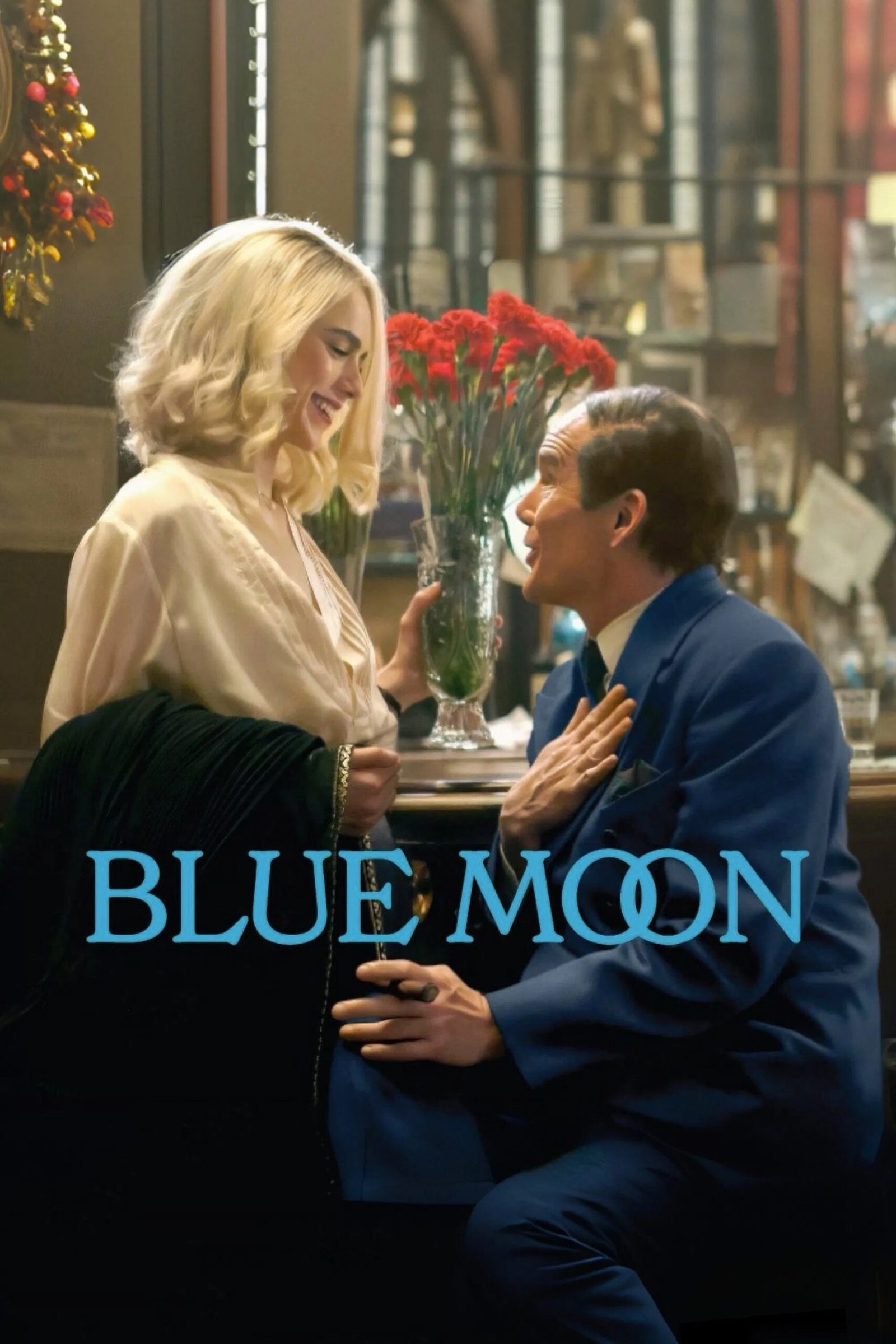
Premise: Lorenz Hart struggles with alcoholism and mental health as he attempts to save face on the opening night of Oklahoma!
Genres: Biography, Drama, Music, History, Comedy, Romance
Runtime: 100 minutes
MPAA Rating: R
Release Year: 2025
Starring: Ethan Hawke, Margaret Qualley, Andrew Scott, and Bobby Cannavale
Directed by: Richard Linklater
Written by: Robert Kaplow
Distributed by: Sony Pictures Classics
Blue Moon is a film about a man who calls everyone else an extra, only to realize he may be fading into the background himself. On March 31, 1943, as Oklahoma! opens on Broadway and reshapes American musical theater, Lorenz Hart (Ethan Hawke) watches his legacy shift from center stage to supporting role inside Sardi’s, sitting just steps away from history as it moves forward without him.
Hart was the cynical half of Rodgers and Hart, the Broadway duo responsible for enduring standards like “The Lady is a Tramp,” “My Funny Valentine,” and the title standard that gives this film its name. His lyrics were sharp, urbane, and emotionally bruised. He thrived on wit that cut just deep enough to sting. But on this night, Hart can feel the shift. Richard Rodgers (Andrew Scott) has partnered with Oscar Hammerstein II (Simon Delaney) for the first time, launching what will become the defining musical collaboration of the twentieth century. The optimism of Oklahoma! leaves little room for Hart’s cynicism.
With the exception of its opening image, the film unfolds almost entirely inside Sardi’s, the legendary Broadway restaurant and bar where actors, composers, and producers gather on opening nights. Linklater stages it like a chamber piece, keeping the camera largely confined to tables and bar stools as conversations stretch and tensions simmer. The Oklahoma! celebration eventually pours into Sardi’s itself, turning what begins as distant triumph into an unavoidable, in-your-face reminder that history is moving forward without Hart. For those of us in Sioux Falls, South Dakota, the energy feels not unlike Minerva’s, where everyone gathers to see and be seen. It is a room full of ambition, ego, and shifting allegiances.
Hart oscillates between charm and self-destruction. He praises Oklahoma! publicly, calling it a triumph. In private, he dismantles it. The sentimentality offends him. The optimism feels naïve. Except when Rodgers is too close. Then the passive aggressive jabs surface almost involuntarily. Hart is the embodiment of Lit’s 1999 hit “I’m My Own Worst Enemy.” He simply cannot help himself. Every compliment carries a sting. Every attempt at reconciliation circles back to insecurity.
Rodgers, portrayed with careful restraint by Scott, is neither villain nor betrayer. He is exhilarated by new creative energy while still carrying visible loyalty to the man who helped make his career possible. The dynamic between the two men is layered with affection, resentment, history, and unspoken understanding. Blue Moon resists easy blame. Their partnership ends not in explosion, but in quiet incompatibility. Rodgers is moving toward a broader emotional canvas. Hart remains devoted to precision and irony. The divide between them feels less like betrayal and more like inevitability.
Elizabeth Weiland (Margaret Qualley) drifts through Hart’s orbit as a 20-year-old Yale student who becomes both protégé and projection. Hart was openly gay, yet he indulges the fantasy of romance, as if proximity alone might become intimacy. He wants to know everything about her, yet she rarely, if ever, asks about him. It becomes one of the film’s most painful throughlines. Hart longs for someone to look at him and say what may be the most devastating line in Casablanca, the one few people ever quote: “Nobody ever loved me that much.” His life feels shaped by the absence of that affirmation.
The “extras,” the supporting cast orbiting Hart, deepen the portrait without overwhelming it. The bartender (Bobbie Cannavale) attempts, with limited success, to manage Hart’s drinking as the evening progresses. A piano player he nicknames Knuckles, an army serviceman on leave (Jonah Lees), becomes an unexpected sounding board as Hart spirals through anxiety and bitterness, absorbing the confessions of a man who cannot get out of his own way.
E.B. White (Patrick Kennedy) appears briefly, the future author of Charlotte’s Web and Stuart Little, mentioning his turn toward children’s literature in a moment that lands with quiet historical irony. Did Hart, in all his wounded wit and small-statured brilliance, offer some intangible inspiration for Stuart Little. And when a young Stephen Sondheim, introduced as “Little Stevie” (Cillian Sullivan), wanders through the room with Hammerstein, theater lovers will immediately recognize that the next era of musical theater is already standing within arm’s reach.
Hart spends much of the evening diminishing the people around him, reducing them to background figures in his own story. Yet he is the one being edged out of the frame. Blue Moon becomes a portrait of artistic displacement, of what it feels like to watch your relevance narrow while the room grows louder without you.
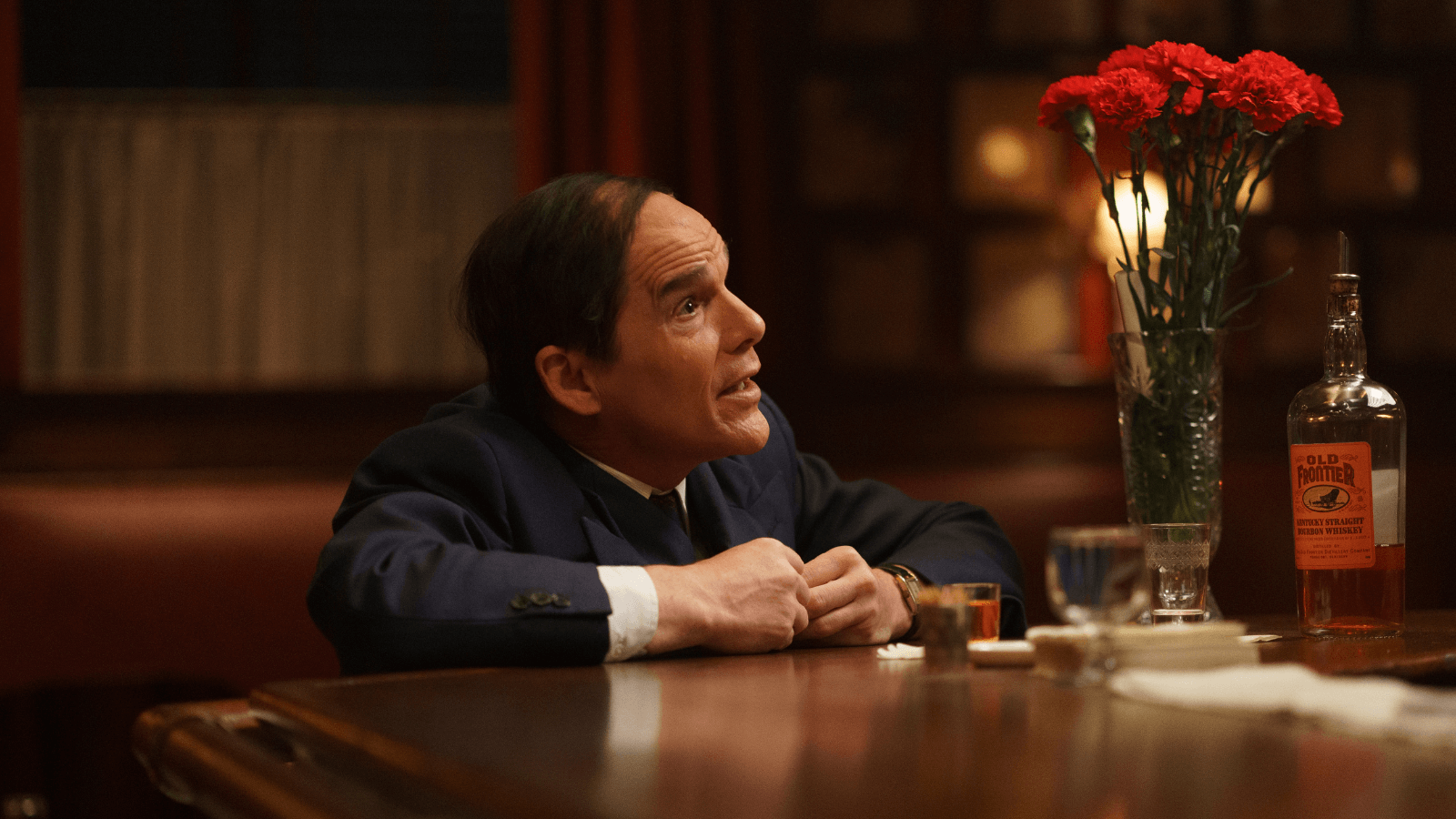
The production design reinforces Hart’s diminishing presence. Hawke, nearly ten inches taller than the real Lorenz Hart, is framed and staged in ways that visually compress his stature. He often appears reduced within the space, a subtle but effective choice that mirrors a lifetime of feeling physically and emotionally overshadowed.
Hawke’s performance anchors the film. This marks his ninth collaboration with Linklater, and their shared restraint shapes the rhythm of Hart’s unraveling. Together, they refuse to turn Hart into a figure of self-pity. The decline unfolds in controlled gestures rather than theatrical breakdowns, revealing insecurity beneath the wit without overstating it. The dialogue traces those fractures with precision, exposing a man who senses his relevance narrowing but cannot articulate the depth of that fear.
At the same time, the film’s commitment to extended conversation and single-location staging can lag. The talky structure is intentional and thematically appropriate, but there are stretches where the energy dips and the momentum slows. It is a dialogue-driven character piece, yet not always a dynamically paced one. That restraint ultimately keeps Blue Moon from reaching something more transcendent.
🧠ADHD Watch Factor
Pacing: Uneven – extended dialogue slows propulsion
Attention Hold: Moderate – Hawke sustains engagement
Distraction Risk: High – single location staging invites drift
Emotional Pull: Subtle – emotion simmers but rarely swells
Chaos Level: Simmering – insecurity beneath composure
What lingers is the tragedy of a man who may not have fully understood his own impact. Hart helped define American musical theater. His lyrics endure. His influence shaped generations. Yet on this night, he feels peripheral, watching history move forward without him.
Blue Moon is modest, classical, and unapologetically performance driven. Its talk-heavy structure will test some viewers, even as Hawke’s work remains undeniable. It may not invite repeat viewings, but for one hour and forty minutes, Lorenz Hart is not an extra. He is the main character, even if he never quite believed it.
Awards Outlook and History:
Blue Moon earned two Academy Award nominations: Ethan Hawke for Best Actor and Robert Kaplow for Original Screenplay, marking Kaplow’s first Oscar nomination. Both categories are highly competitive this year, and the nominations will stand as the film’s highest level of recognition this season.
Hawke’s campaign has included nominations at BAFTA and the Actor Awards, formerly known as the Screen Actors Guild Awards, as well as recognition from the Critics Choice Awards and the Golden Globes, where the film was nominated for Best Comedy or Musical. Internationally, Andrew Scott won the Silver Bear for Best Supporting Performance at the Berlin International Film Festival.
The film’s awards strength rests firmly on performance and writing rather than broad category reach.
Where to Stream: