
Recasting Oscar History – 1931
Who would have won Best Casting at the 4th Academy Awards?
July 20, 2026 | Lisa Hatzenbeller
By the 4th Academy Awards, early sound filmmaking was beginning to sort out which kinds of performers could survive in very different screen environments. The Best Picture field asked for booming frontier presence, rapid-fire newsroom timing, credible child performance, physical adventure casting, and polished melodramatic restraint.
For Recasting Oscar History, that makes the alternate Best Casting race less about one dominant industry shift than about range of screen demands. One film has to populate a decades-spanning western epic. Another depends on verbal speed and pressroom chemistry. A child-led story needs young performers who can carry comedy and sentiment without seeming manufactured, while the adventure and melodrama nominees rely on physical credibility, glamour, refinement, and emotional control.
For this project, we imagine how the Academy might have answered a Best Casting question within that recorded field. The 4th Academy Awards honored films released between August 1, 1930, and July 31, 1931, with winners announced on November 10, 1931. Because the documented Outstanding Production field contains exactly five titles, all five move directly into this alternate Best Casting race.
Outstanding Picture Nominees
Cimarron*
Total Oscars: 3 Wins • 7 Nominations
Acting Oscars: 0 Wins • 2 Nominations
East Lynne
Total Oscars: 0 Wins • 1 Nomination
Acting Oscars: 0 Wins • 0 Nominations
The Front Page
Total Oscars: 0 Wins • 3 Nominations
Acting Oscars: 0 Wins • 1 Nomination
Skippy
Total Oscars: 1 Win • 4 Nominations
Acting Oscars: 0 Wins • 1 Nomination
Trader Horn
Total Oscars: 0 Wins • 1 Nomination
Acting Oscars: 0 Wins • 0 Nominations
* Indicates winner in its top-picture category
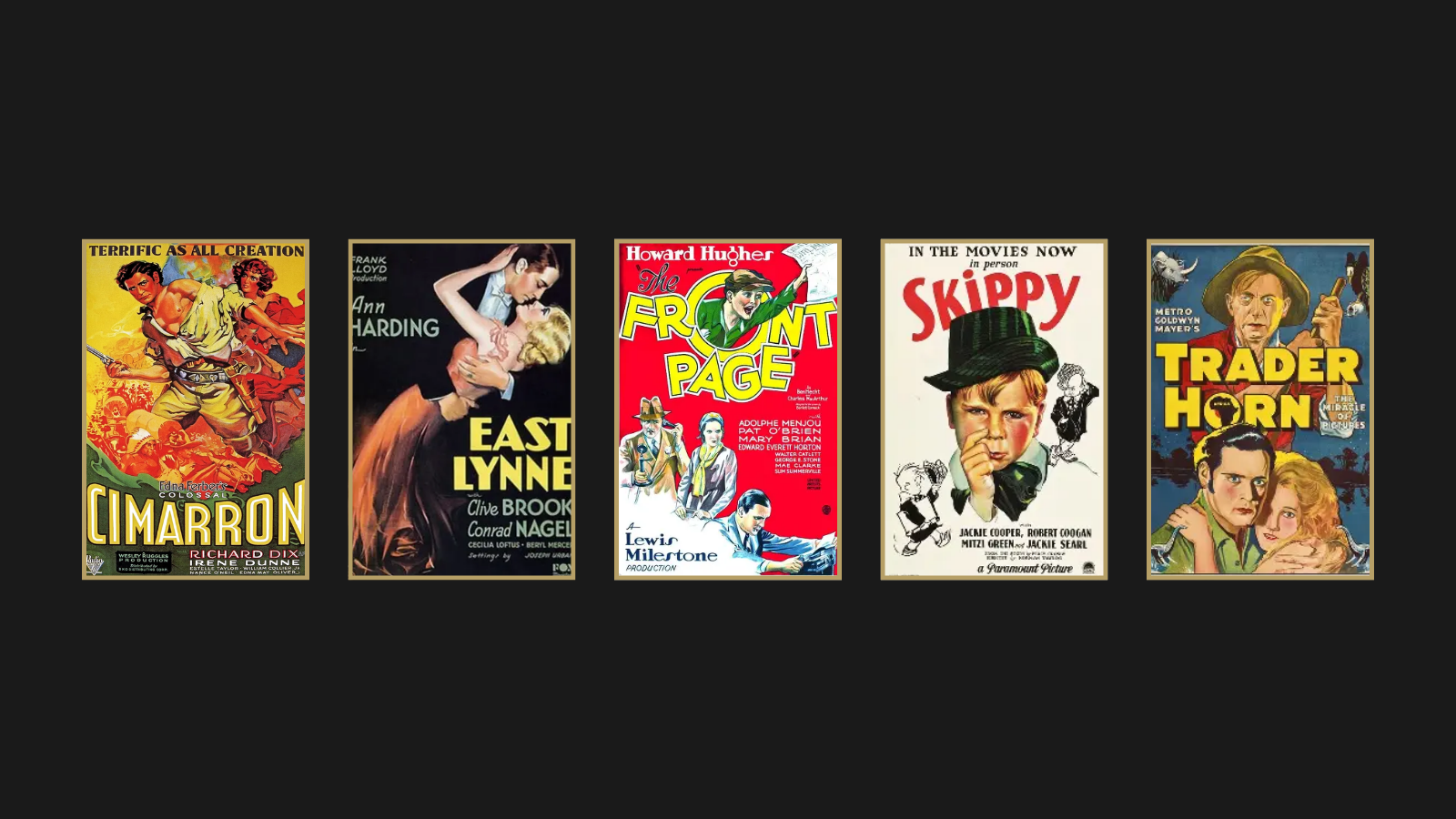
Who Would Have Won?
The films below are ranked through the Best Casting lens, weighing ensemble construction, casting difficulty, breakout value, chemistry, role-to-performer fit, and how strongly the cast shapes the film’s identity.
5ᵗʰ Place
East Lynne
Key Cast: Ann Harding, Clive Brook, Conrad Nagel, Cecilia Loftus
Casting Evaluation
East Lynne depends on a classical melodrama structure, so its casting has to keep sacrifice, shame, and social judgment emotionally controlled rather than merely decorative. The performers are well matched to that register: dignified suffering, cultivated temptation, household severity, and respectable stability. The result is polished and coherent, though more traditional than surprising.
Why This Casting Worked
- Ann Harding gives the film its clearest casting argument, bringing poise and vulnerability to material that could easily become overwrought.
- Clive Brook’s cultivated screen manner helps make temptation feel socially credible rather than lurid.
- Conrad Nagel balances the triangle with calm authority, giving the domestic half a stabilizing presence.
- Cecilia Loftus contributes the kind of stern character presence needed to make the home feel emotionally restrictive.
Where the Casting Fell Short
The ensemble is handsomely assembled, but it rarely feels distinctive beyond the demands of the source material. Its strongest choices are tasteful rather than transformative.
Casting Takeaway
Polish and control are the achievement here, even if the roles remain more conventional than surprising.
4ᵗʰ Place
Trader Horn
Key Cast: Harry Carey, Edwina Booth, Duncan Renaldo, Mutia Omoolu, Olive Carey
Casting Evaluation
Trader Horn has a real casting case because it asks performers to function inside a production built around danger, location spectacle, and physical exposure. Harry Carey’s rugged authority is the film’s anchor, while the younger players give the expedition shape and contrast. But the ensemble is limited by role design: the casting creates adventure texture more than interpersonal complexity, and several parts are trapped inside the era’s exotic-adventure conventions.
Why This Casting Worked
- Harry Carey’s frontier-tested screen persona makes the title figure feel experienced before the plot has to explain him.
- Edwina Booth’s casting gives the film a striking visual centerpiece and a sense of risk tied to the production’s physical demands.
- Duncan Renaldo works as a younger counterweight, letting Carey’s authority register through contrast.
- Mutia Omoolu’s presence materially affects the expedition dynamic, even within a role shaped by narrow studio-era assumptions.
- Olive Carey adds a small but useful emotional connection to the story’s backstory.
Where the Casting Fell Short
The film’s casting ambition is inseparable from spectacle, but the character relationships are thin. It has adventurous bodies in difficult conditions, not the strongest ensemble architecture.
Casting Takeaway
The ensemble’s value comes from physical commitment and weathered adventure presence more than from complex character interplay.
3ʳᵈ Place
Cimarron
Key Cast: Richard Dix, Irene Dunne, Estelle Taylor, Edna May Oliver, Roscoe Ates, George E. Stone
Casting Evaluation
Cimarron asks its cast to cover a long historical span without losing the central contrast between public mythmaking and domestic endurance. The strongest casting idea is that imbalance: one side of the film is built around swagger, speechmaking, and restless expansion, while the other depends on steadiness, adaptation, and emotional continuity. Around that pair, the supporting cast gives the town color and social texture, though the ensemble is more uneven than the film’s scale first suggests.
Why This Casting Worked
- Richard Dix’s booming presence matches the film’s appetite for frontier myth and public performance.
- Irene Dunne gives the cast its most stabilizing force, making Sabra’s evolution feel central rather than secondary.
- Dix and Dunne create a useful imbalance: his restlessness pushes outward while her composure holds the story together.
- Estelle Taylor brings a more worldly charge, widening the film beyond homestead respectability.
- Edna May Oliver’s character-actor sharpness helps the community scenes avoid total stiffness.
- Roscoe Ates contributes a recognizable early-sound comic presence that differentiates the town ensemble.
Where the Casting Fell Short
The film’s size is also its casting problem: not every role is integrated with the same precision. Some supporting figures register as types in a panorama rather than essential pieces of an ensemble.
Casting Takeaway
The central pairing works because public bravado and emotional continuity are cast as opposing forces.
Runner-Up
Skippy
Key Cast: Jackie Cooper, Robert Coogan, Mitzi Green, Jackie Searl, Willard Robertson, Enid Bennett
Casting Evaluation
Skippy is one of the ceremony’s clearest casting achievements because it builds an entire film around children without treating them as decorative cuteness. The central challenge is tonal control: the cast has to move from prankish comic business into sincere distress while still feeling like neighborhood kids. Jackie Cooper’s nomination supports the film’s casting case, but the larger achievement is the child ensemble’s balance of mischief, rivalry, loyalty, and open emotion.
Why This Casting Worked
- Jackie Cooper gives the film its breakthrough value, making Skippy impulsive, funny, stubborn, and emotionally available.
- Robert Coogan keeps the friendship from becoming one-sided, giving Sooky a wounded, grounded presence.
- Cooper and Coogan make the class difference between the boys legible without losing the looseness of child play.
- Mitzi Green brings professional juvenile confidence, adding comic lift without pulling focus from the central friendship.
- Jackie Searl’s sharper energy gives the children’s world conflict and hierarchy.
- Willard Robertson and Enid Bennett help define the adult boundaries around a film that belongs emotionally to the children.
Where the Casting Fell Short
The adult roles are functional and supportive, but they are less individually memorable than the young cast. The film’s casting identity is powerful but narrow.
Casting Takeaway
The young performers carry comedy, heartbreak, and social feeling from inside a child’s world rather than an adult’s idea of one.
Winner
The Front Page
Key Cast: Adolphe Menjou, Pat O’Brien, Mary Brian, Edward Everett Horton, Walter Catlett, Mae Clarke, George E. Stone
Casting Evaluation
The Front Page wins because its casting is the most structurally essential to the film’s design. This is not just a star-and-supporting-players arrangement; it is a pressure system. The film needs verbal speed, newsroom cynicism, comic timing, professional rivalry, moral slipperiness, and sudden jolts of vulnerability, all operating in a cramped ensemble space. Menjou and O’Brien provide the central engine, but the supporting cast gives the pressroom its rhythm, hierarchy, and bite.
Why This Casting Worked
- Adolphe Menjou’s smoothness makes Walter Burns dangerous because he can sound charming while behaving ruthlessly.
- Pat O’Brien’s harder energy keeps Hildy from being swallowed by Menjou’s polish.
- Menjou and O’Brien create a sharp comic power struggle: one manipulates, the other pushes back with speed and irritation.
- Edward Everett Horton adds a different comic texture, making the pressroom feel like a collection of distinct professional egos.
- Walter Catlett strengthens the ensemble’s rat-a-tat rhythm, helping the newsroom feel busy rather than merely crowded.
- Mae Clarke’s presence gives the film a necessary emotional break from cynicism, proving the cast can do more than banter.
- Mary Brian helps externalize what Hildy might lose if he cannot escape the newspaper world.
Where the Casting Fell Short
The film is so dependent on its central male professional world that some emotional roles are necessarily brief. Its women matter, but the ensemble architecture still prioritizes the pressroom machine.
Casting Takeaway
The pressroom comes alive through speed, ego, cynicism, and professional friction, all packed into one volatile comic space.
Final Verdict
The Recasting Oscar History winner for the 4th Academy Awards is The Front Page.
East Lynne is carefully cast, but its case is smaller than the films built around faster ensemble rhythm, greater physical demands, or more difficult child-centered work. Trader Horn earns credit for placing its actors inside unusually demanding conditions, but the casting is still more persuasive as production texture than as a fully shaped dramatic unit. Cimarron has the biggest Oscar footprint and the most expansive production canvas. Its scale and ambitious time span give it a major casting case, though the sweep does not produce the same ensemble precision as the strongest nominees. Skippy is the closest challenger, with young performers who make the film’s comedy, loyalty, and hurt feel immediate rather than manufactured.
The Front Page wins because its cast gives the film a force no set, premise, or headline could create alone. The newsroom lives through sharp contrasts in temperament, status, urgency, and self-interest, with each player adding pressure to the next. The result is a comedy whose movement, bite, and authority come directly from the people chosen to crowd the room.