
The Baltimorons
February 13, 2026 | Lisa Hatzenbeller

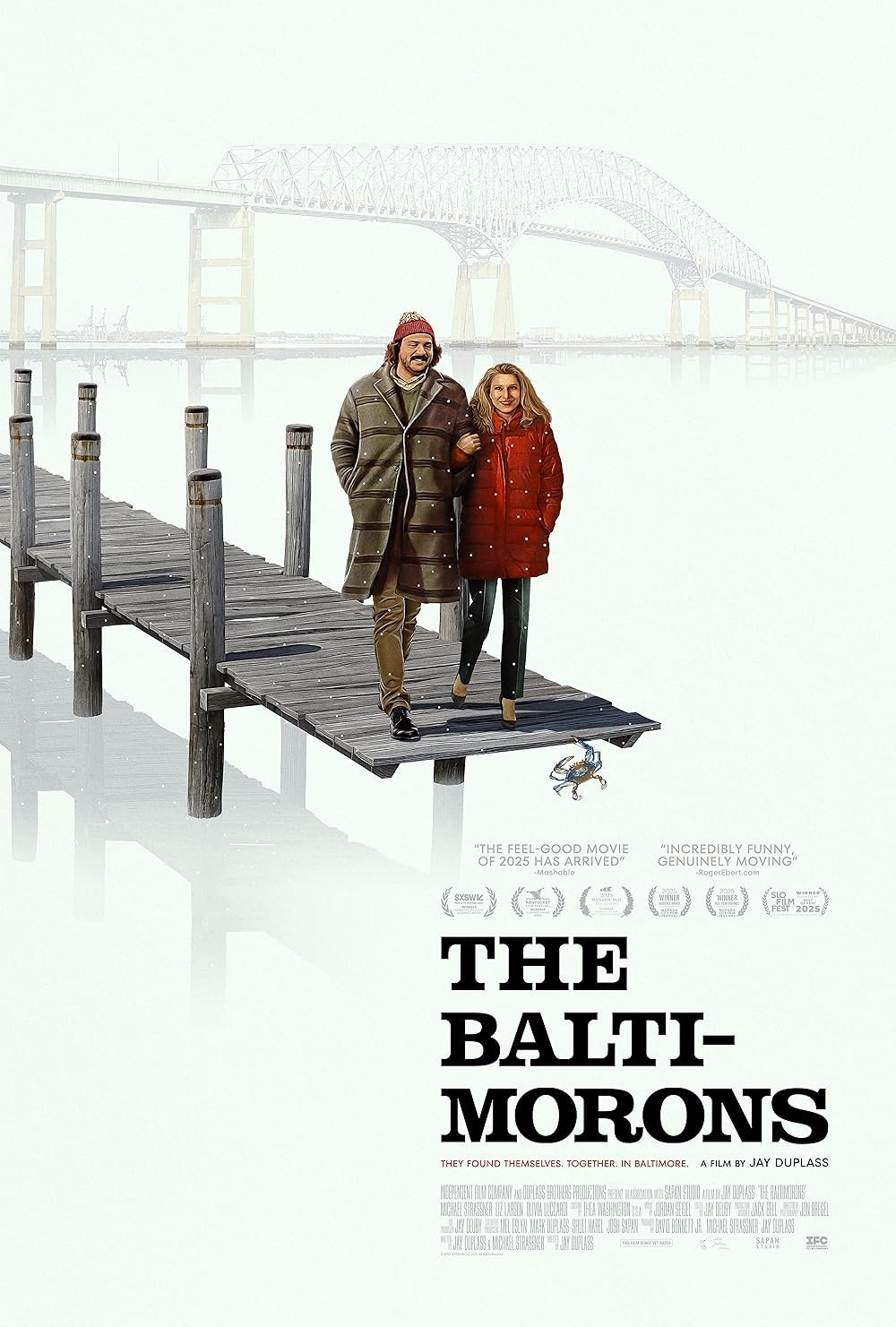
Premise: A newly sober man’s Christmas Eve dental emergency leads to an unexpected romance with his older dentist as they explore Baltimore together.
Genres: Comedy, Romance
Runtime: 101 minutes
MPAA Rating: R
Release Year: 2025
Starring: Liz Larsen, Michael Strassner, and Olivia Luccardi
Directed by: Jay Duplass
Written by: Jay Duplass and Michael Strassner
Distributed by: IFC Films and Sapan Studios
The Baltimorons is a deceptively tender May-December romance that opens on a small but humiliating disaster. Cliff, played by Michael Strassner, is a recovering alcoholic and former comedian who chips his tooth on Christmas Eve, six months into sobriety and already walking a fragile line in his relationship. He is trying to rebuild his life with his fiancée Brittany, played by Olivia Luccardi, whose love for him often manifests as vigilance. She worries, she checks in, she even tracks his phone. They both want stability, but they do not always agree on what that looks like.
An opportunity to perform later that evening exposes the tension between stability and self-expression. Cliff insists he does not need to go, but it is clear that stepping on stage is the only thing he truly wants. Before that conflict can fully play out, a sudden dental emergency forces him into the Baltimore night in search of a Christmas Eve dentist, turning a strained holiday into something far more unpredictable.
Enter Didi, played by Liz Larsen, a divorced dentist and grandmother who agrees to see Cliff on short notice. She fits him for a temporary filling while he drifts somewhere between humiliation and nitrous-fueled confidence. With a plastic gag holding his mouth open, Cliff’s comedic instincts surface, turning a routine appointment into awkward flirtation. Didi counters with dry, perfectly timed one-liners, including, “I’m going to have to fit you for a muzzle,” all while maintaining professional composure.
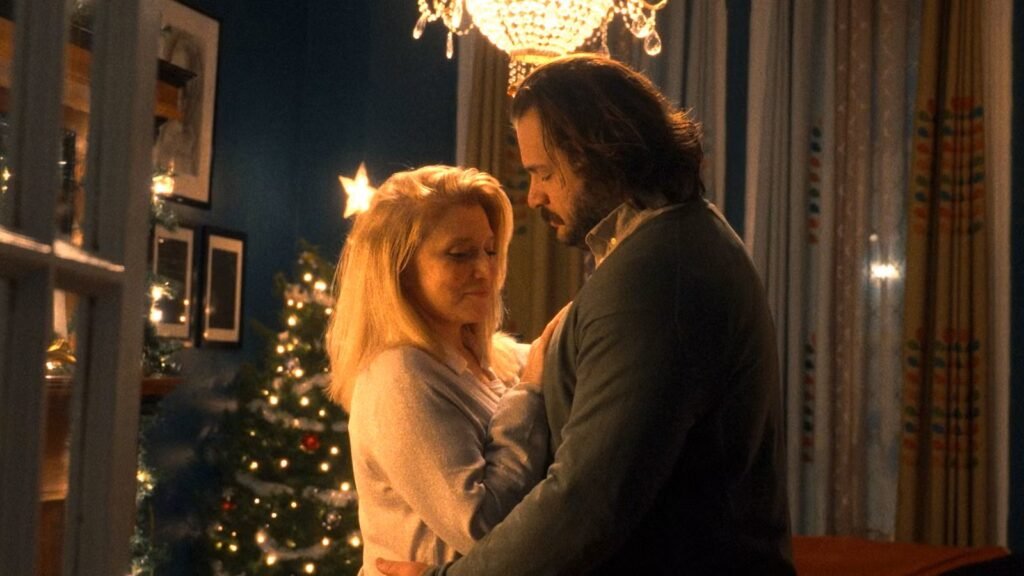
She attributes the chemistry to laughing gas and carries on, until a phone call from her daughter quietly derails her evening plans. Cliff overhears enough to sense the disappointment she tries to conceal and instinctively offers to make the night better. She declines. Then they step outside and discover his car has been towed. Didi offers him a ride to retrieve the car so he can get back to his fiancée, but what begins as a practical favor slowly unfolds into something far more unexpected over the next twenty-four hours.
What follows is a series of apparent misfortunes that gradually reveal themselves as moments of intimacy. Each small setback becomes an opportunity for personality to surface. Their fondness grows not in grand gestures, but in the quiet spaces between them. The age difference is undeniable, and Cliff’s engagement looms over every interaction, yet the film leans into the ambiguity rather than resolving it. Are they flirting, or simply connecting? Is this romance, or two people recognizing something in each other at the exact moment they need it most?
No matter the circumstance, what becomes clear is that they do not want the night to end. They want to remain in each other’s orbit. That orbit expands to unexpected places, including her ex-husband’s wedding celebration and Cliff meeting her family. From the beginning, Cliff carries a protective energy toward Didi, a quiet desire to make her feel seen. With each encounter, Didi’s reserve softens. We watch her let him in, slowly and carefully. The night ultimately circles back to the improv stage, where performance and vulnerability blur into something that feels almost confessional.
What makes their connection linger is not just the flirtation, but the honesty underneath it. The Baltimorons settles into something more human than a conventional romantic comedy. Cliff and Didi are not blank-slate archetypes. They are people shaped by addiction, divorce, regret, and responsibility. At some point, the distance between them collapses, and we recognize pieces of ourselves in the way they hesitate, deflect, and ultimately lean in.
🧠ADHD Watch Factor
Pacing: Steady – dialogue drives momentum
Attention Hold: High – Didi’s entrance locks focus
Distraction Risk: Low – no narrative drift
Emotional Pull: Growing – connection deepens naturally
Chaos Level: Controlled – more vulnerability than volatility
The conversation between Cliff and his fiancée Brittany becomes one of the film’s most grounded moments, forcing us to confront the reality of loving someone in recovery. Addiction does not disappear when romance arrives, and the emotional weight of that truth ripples outward. The film does not treat it lightly.
Shot on a modest budget, director Jay Duplass turns imperfection into texture rather than liability. The film is not chasing polish. It is chasing honesty. As the night stretches into morning, what lingers is not spectacle but vulnerability. Two people choosing to stay. Two people willing, despite history and hesitation, to shoot their shot at love. For a story that begins with discomfort and detours, it ultimately earns its warmth.
Awards Outlook and History:
The film was named one of the National Board of Review’s Top Ten Independent Films and won the Narrative Spotlight Audience Award at SXSW. It is nominated for the John Cassavetes Award at the Film Independent Spirit Awards, where its strongest competition appears to be Eephus. Liz Larsen is also nominated for Best Breakthrough Performance and currently feels like the one to beat, though Kayo Martin in The Plague could emerge as a challenger. The ceremony takes place on February 15.
Where to Stream: