How Twin Peaks Changed Television Forever
The show that proved network TV could be cinematic, surreal, and unapologetically strange.
February 24, 2026 | Lisa Hatzenbeller
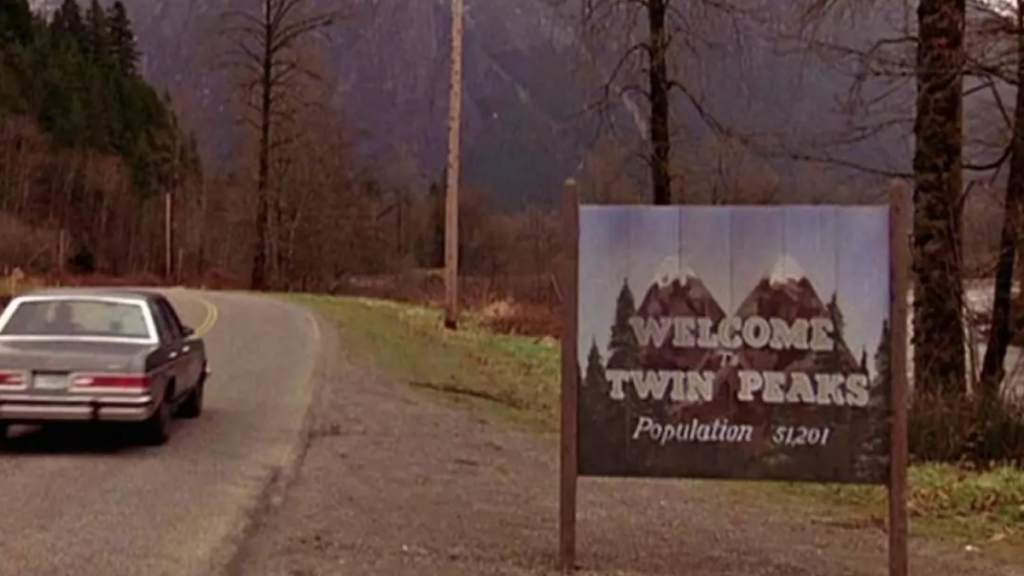
February 24, 1989. 1:30 PM.
An FBI agent named Dale Cooper crosses into a small logging town called Twin Peaks to investigate the murder of Laura Palmer. On the surface, it resembles the beginning of a conventional crime procedural: an outsider detective, a dead homecoming queen, a grieving community.
What followed was anything but conventional.
Twin Peaks did not simply tell a story. It destabilized the expectations of network television at a moment when those expectations were rigid. It introduced ambiguity where clarity was standard. It centered atmosphere where plot traditionally ruled. In doing so, it quietly altered the trajectory of the medium.
Television would never look or feel the same.
Before the Fog Rolled In
To understand why Twin Peaks landed like a shock, it helps to remember how structured late-1980s network television was. Primetime was built around reliability. Crime dramas resolved their cases within an hour. Sitcoms restored equilibrium before the credits rolled. Even serialized storytelling was structured so that audiences could miss an episode without losing the thread. Television prioritized clarity, accessibility, and repetition.
Visually, the medium reflected that philosophy. Lighting was functional. Editing was efficient. Directors operated within a stable grammar rather than imprinting a distinct cinematic voice. Television was engineered for comfort.
Twin Peaks entered that landscape and treated primetime not as a slot to fill, but as a canvas to disturb.
Cinema Invades the Living Room
From its pilot episode, directed by David Lynch, the series announced itself visually before it did narratively. The camera lingered in ways that felt almost defiant. Silence stretched beyond what network rhythm normally tolerated. Darkness swallowed corners of the frame. Scenes unfolded with the deliberate patience of art-house cinema rather than the efficiency of broadcast television.
This was not aesthetic indulgence. It was authorship.
At a time when television was still largely treated as a writer-and-producer medium where directors were often considered interchangeable, Twin Peaks carried a palpable creative identity. It felt shaped rather than assembled. Viewers were not simply following a narrative; they were inhabiting a mood.
Lynch’s influence was unmistakable. This was a filmmaker known for Blue Velvet bringing surreal, unsettling sensibilities into primetime. The result was television that felt authored rather than assembled. At a time when TV was largely considered writer-driven and director-for-hire, Twin Peaks carried a palpable creative identity. The show didn’t feel assembled by committee. It felt shaped by a point of view.
Today, “cinematic television” is marketing language. In 1990, it was destabilizing. Viewers were being asked not just to follow a plot but to inhabit an atmosphere.
Just as disruptive was the show’s refusal to stay inside a single genre. Twin Peaks fused murder mystery, soap opera melodrama, supernatural horror, and absurdist comedy without warning the audience when one mode ended and another began. In one scene, grief was raw and sincere. In the next, the show leaned into the ritual of damn fine coffee and cherry pie. Moments later, it dropped viewers into the Red Room, where logic dissolves and meaning becomes symbolic rather than literal.
Network TV in the late 1980s was compartmentalized. Genres existed in distinct lanes. Twin Peaks blurred those lanes until they dissolved—and it trusted the audience to keep up.
That trust was part of the revolution.
The Mystery That Was Never About the Answer
The question “Who killed Laura Palmer?” quickly became a cultural phenomenon, a national obsession. It fueled speculation in newspapers and magazines, sparked conversation in offices and classrooms, and turned Twin Peaks into appointment television. Viewers were not simply watching a series; they were participating in an unfolding mystery that invited interpretation and communal theorizing. It created a form of communal engagement that feels normal now, but was less common in that era’s primetime ecosystem.
That kind of success comes with built-in expectations. If the mystery is the engine, then the audience expects a payoff. The show’s popularity created a structural tension between the series and ABC. From a network perspective, mysteries are problems to be solved because solutions can be marketed, promoted, and framed as major television events. The decision to reveal Laura Palmer’s killer during the second season followed that reasoning. Closure was seen as necessary to sustain mainstream momentum.
But Twin Peaks was never truly constructed as a conventional whodunit. The murder investigation was a framework, not the destination. The series used the mystery as a doorway into something larger: the feeling of a town vibrating with secrets, the sense of dread humming beneath ordinary routines, the suggestion that evil might not be a single act but an atmosphere. The show’s power lived in the hum of electricity in the woods, in the unease of small-town intimacy, in the symbolic logic of the Black Lodge.
Yet the reveal exposed a deeper misunderstanding of what Twin Peaks actually was. The mystery had functioned less as a destination than as a doorway. It drew viewers into the town, but it was never the sole engine of the series. What sustained the show was its atmosphere: the persistent hum of electricity in the woods, the ominous stillness of the Black Lodge, the sense that something metaphysical lingered beneath everyday interactions. The crime investigation provided structure, but the emotional and aesthetic experience provided meaning.
So when the central question was treated as the product – rather than as an entry point – the series inevitably changed shape. This wasn’t about audiences “hating answers.” It was about the fact that Twin Peaks drew people in with a mystery, then held them with mood, tone, and spiritual unease. The experience was never only about closing the case. It was about living inside uncertainty. In that sense, Twin Peaks revealed something television executives were slower to accept: audiences could tolerate ambiguity if the experience was compelling enough. The industry would later build entire eras of storytelling on that truth, but Twin Peaks demonstrated it early – messily, publicly, and with permanent impact
The Story Without a Center
Another radical element of Twin Peaks lies in its destabilization of narrative centrality. Although Dale Cooper functions as the audience’s guide into the town, the story does not ultimately belong to him. From the first episode onward, the true gravitational force is Laura Palmer – our “main character” who is already dead. Her absence shapes the emotional architecture of the series. Every secret, every fracture, every denial within the town traces back to her.

This structural choice quietly disrupts one of television’s foundational assumptions: that a story requires a singular, stable main character to anchor coherence. Traditional network dramas rely on a clear protagonist whose arc provides narrative momentum. Twin Peaks resists that model.
Dale Cooper functions as the audience’s guide, and structurally he resembles a traditional protagonist. He drives into town. He investigates. He provides continuity. But the story does not ultimately belong to him. It belongs to the emotional vacuum Laura leaves behind.
In this way, the series reframes what it means to be a “main character.” The role is not fixed to the most visible figure on screen. It can belong to an absence that exerts pressure on everyone else. It can belong to a town whose identity is shaped by what it refuses to confront. Twin Peaks suggests that narrative centrality does not require dominance; it requires gravity.
By allowing the story’s center to remain unstable, the show expands the boundaries of television structure. It proposes that coherence can emerge from fragmentation and that a series does not need a single, clearly defined protagonist to sustain emotional investment. Centrality does not depend on screen time or survival. It depends on what everything else moves around. That flexibility would later become common in ensemble-driven and prestige television, but Twin Peaks demonstrated it on network TV at a moment when such experimentation was rare.
Sometimes the main character is not the one who speaks the most or drives the plot forward. Sometimes it is the one whose absence reorganizes the world.
The Ripple Effect
The influence of Twin Peaks is less about direct imitation and more about permission: permission for television to be atmospheric, ambiguous, tonally unstable, and visually authored.
You can see its fingerprints in The X-Files, which blended procedural structure with dread and mythology while allowing unanswered questions to become part of the appeal. You can see it in Lost, which turned mystery into communal participation and trained audiences to treat theorizing as part of the experience. You can see it in The Sopranos, which helped normalize the idea that television could be cinematic and morally ambiguous without resolving into comfort. You can see it in Breaking Bad, which refined slow-burn transformation into prestige structure, trusting patience more than constant plot acceleration. You can see it in True Detective, which leaned hard into atmosphere, philosophy, and dread as narrative engines.
Even contemporary streaming series that blend horror, humor, and small-town unease operate in a landscape that Twin Peaks helped legitimize. The show didn’t invent complexity, but it made complexity commercially conceivable on a mainstream stage—and it made tonal risk feel like artistry rather than error.
That changed what creators could pitch, what networks could greenlight, and what audiences came to expect. It made risk commercially conceivable.
Ahead of Its Time – Twice
When Twin Peaks: The Return premiered in 2017, it didn’t feel like nostalgia. It felt aligned with the streaming era’s appetite for experimentation: long-form structure, narrative abstraction, creative autonomy, and episodes that resist tidy conventional shape. What once seemed radical in 1990 now resembled the language of prestige streaming.
Rewatching the original series today reinforces the same point. Its pacing mirrors the patience of modern limited series. Its tonal hybridity anticipates contemporary genre experimentation. Its ambiguity feels less like confusion than confidence, because the show is committed to the experience it’s creating rather than apologizing for it.
Perhaps the most enduring legacy is psychological. Twin Peaks helped train audiences to tolerate silence, to sit with discomfort, to accept that not everything must be immediately explained. It treated uncertainty as a feature rather than a flaw. In a medium once defined by resolution, that shift was seismic.
Final Thoughts
Dale Cooper’s arrival in Twin Peaks marked more than the beginning of a murder investigation. It signaled a shift in what television was willing to attempt. By embracing cinematic authorship, refusing genre boundaries, and trusting audiences with ambiguity, Twin Peaks expanded the limits of network storytelling—whether the networks understood what they were holding at the time or not.
Its influence isn’t only visible in the shows that borrowed its mood or structure. It’s visible in the broader permission slip it helped write for the medium: that television could be strange without being niche, cinematic without being film, and emotionally unresolved without being broken. It could ask viewers to live inside uncertainty and still keep them watching.
That’s why Twin Peaks didn’t just change television “forever” as a hype line. It changed the rules of what television could be—how it could look, how it could feel, and how much it could demand from its audience.
And the industry has been negotiating that change ever since.